Kill Your Fill: Five Dreaded Filler Words in Fiction

I’ve been working on editing a novel today – it was that great feeling where you get sucked into a project and don’t want to stop. It felt great. Then I decided, “Maybe I’ll spend a few minutes working on getting rid of my filler words.”

Filler words are those words that 90% of the time need to be cut from a manuscript. It seems like no big deal – I mean how bad can the word “then” be? It’s harmless right? And has actual uses. Until you hit Ctrl+F and find it’s in your manuscript over 300 times – and about 282 of those can be deleted. Those aren’t the exact numbers, but they aren’t far off either. Working through my bespoke list of filler words today shrank my manuscript by over 1500 words. And I’m not done with the list yet. Ugh.

I don’t need spell check, I need a “don’t use that word” alarm.

There are many lists of filler words online – but I have refined my list over the last couple years to specifically focus on words that creep into fiction, and those that I personally overuse. Here are my top five filler word nemeses.

  1. Just – outside of quoted dialogue (and even sometimes inside of it) this word can be cut 98% of the time.
  2. Thought/realized – if you’re in a close point-of-view of any kind you can usually write the idea without having to clarify that this particular character “thought” about it.
  3. Then – as mentioned before this one sneaks into almost all of my narrative prose. You don’t need to telegraph every dang action your characters take. They can just do it.
  4. So – I start a lot of my dialogue with this word. Not brilliant word craft, Jenel.
  5. There – While I don’t use this one quite as frequently as the others, it’s almost always in places where I could be more specific, or where I don’t need any word at all.

They say one of the keys to editing is to “Kill Your Darlings.” I think my new motto should be “Kill Your Fill.”

5 U.S. Historical Fiction books in Honor of Independence Day

Fireworks! Hot Dogs! Books? Okay, well not a traditional way to celebrate – but I thought I’d make a list of five of my favorite U.S. historical fiction books in honor of Independence Day!

  1. To Kill a Mockingbird by Harper Lee – some books really are as good as everyone says they are. This books gives a very specific window into childhood, racism, the legal system, stereotypes around mental illness/disability, and does it all with a unique narrative lens. I will judge you if you haven’t read this book πŸ™‚
  2. The Little House on the Prairie series by Laura Ingalls Wilder – when people ask me how I first got interested in American history I trace it to this series about a quintessential pioneering family.
  3. Molokai by Alan Brennert – This is one of the best books about the history of Hawaii and the devastating history of Hansen’s Disease in the United States. Plus it’s just a really, really good story.
  4. The Water Dancer by Ta-Nehisi Coates – In my Goodreads review of this book I said it’s not often that the fantasy geek, writer geek, and history geek in me can all be delighted by the same book, but this is one of them. If you can do justice to the history of slavery, and still make a book uplifting and magical, that’s definitely worth reading.
  5. Fools Crow by James Welch – reading this book in college gave me my first taste of the ability of some authors to put me in the shoes of someone of another culture, in this case a young man of the Blackfeet Nation, while still telling a compelling and relatable story.

Happy Fourth everyone!

Photo Credit: Paul_Stachowiak via Pixabay

Brightness of hope

It’s been a rough year – I lost my mom a few months ago, and that’s just one of those challenges that makes you wonder how we humans walk around with ragged holes in our hearts. Add to that extra craziness at the day job, stressful medical news of my own, etc. etc. etc.

But I’m still in my MFA program – I’ve got all kinds of projects in the works and with a little bit of summer break headed my way (thank you academia!) I’m feeling brighter and more creative by the minute. So here’s a hopeful little haiku.

Brightness of Hope
Dark, on ink, on black
Still, shadow suggests the morn
Squint, pray, wait, pray – dawn

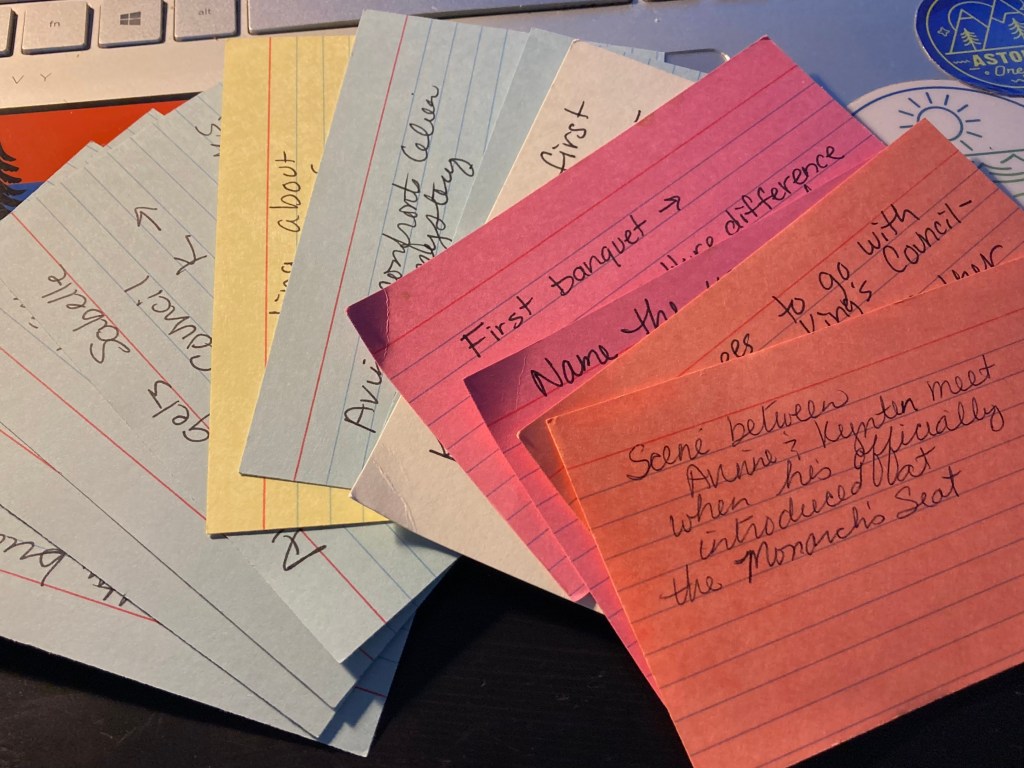
Index Card Inbox

I did this last night as part of my effort to better stay motivated on my writing goals this month.

This is a trick that a lot of writers use – I’ve even done it using Post-It Notes on the wall, but in this case I wanted my tasks to be a little more portable. I tend to need this when I’m in the middle of a novel trying to work my way out, and trying to manage both new scenes I need to write and revisions I’m going to need in what is already written.

You take your cards or your sticky notes and you write down scenes you need to write or problems you need to solve – in my experience aiming for tasks that should take you about 30 minutes or less is ideal. Then when you have time to write you don’t have to stress about what to work on – you just pick a card and get to work. I think this trick is especially good for those of us who don’t necessarily like to work on our novels or other big projects in any kind of strict order. The cards not only serve as a To Do list, but as a method of organizing the chaos.

NaNoWriMo Thoughts

I love the idea of National Novel Writing Month. Love the idea of clear goals and a deep commitment to finishing a project and working every day. The organization it’s attached to is so encouraging and has awesome resources – the whole concept of it makes me feel a sort of sunbeams and chocolate and Disney Princess style happy. But…

I’ve never done it.

Part of it is the timing – for a person whose day job is connected to the academic calendar November is never going to be an easy month for giant projects, add that to nap inducing shorter days, a semi-stressful travel heavy holiday, and …well, you get the idea.

Plus, every time NaNoWriMo has come along and I have been wholly in writer mode I’m always in the middle of some other project. As tempting as it might be to play with a shiny new toy I have the companion novel to Rell to finish, MFA class assignments to write, and a whole other novel that’s finished, but needs a lot of edits before it’s ready to go anywhere.

So maybe I need to make this month National Novel Finishing Month – or at least National Minimal Procrastination on My Writing Goals Month – which doesn’t have the same ring to it, but may be just as important for me.

Short Story Contest

Wow! I can’t believe it’s been July since I posted last – the one downside to full time job, plus grad school, plus life is that it doesn’t leave a lot of time for extras like the blog. I’d like to promise to do better, but I hate breaking promises.

This last week I’ve been working on an entry for SNHU’s Fall Fiction Contest. The prizes for the winners include SNHU scholarships, so for a person paying for their degree out of pocket it seemed like something I needed to participate in. The trick for me is that I struggle with short stories. Luckily, I had worked on a very short story (less than 800) words over the summer as a writing challenge to myself and so I decided to polish it up and enter it. I’m really grateful for my husband, my cousin (the Queen of Short Stories), and a helpful work friend for helping me in that effort.

My biggest goal in entering the contest, knowing it might be read by professors at SNHU was not to embarrass myself. I think that I at least reached that goal. If nothing else, I like the story, which is important. In previous writing classes I’ve submitted things just to have something to submit, and it’s always hard when you aren’t even excited about your work.

I should know by late November how things worked out with the contest – it’s open to the public so I have no doubt the competition will be fierce. I’m trying not to worry to much about what happens from here. I’ve done my part – the best thing to do is move on to the next project. And thanks to my homework for my MFA classes, there is always a next project πŸ™‚

One class down….

So I’ve just started on my second MFA class – Advanced Studies in Literature. I was able to finish my first class with an A and it’s nice to know that a decade out of my last degree I can still pull this thing off.

My favorite thing about that first intro class was that it asked us to take ourselves seriously as writers and to look toward what kind of career we wanted and how the program could help us. I have a day job I love, but writing is still intrinsic to who I am and one wish I had for enrolling in an MFA program was that it would help me focus in on that. Not only did I keep up with the coursework but I’m over 130 pages into the follow up novel for Rell after being stalled out for quite a while, which is exciting.

Here’s hoping I can keep up the pace!

Surviving Negative Feedback: An Affirmation

So joining an MFA program has, no surprise, sucked up a lot of my time in the last couple of months, but I think I’m going to try to start sharing out some of what I’m doing in my classes to the blog. This wasn’t technically an assignment, but we’re talking a lot about workshopping and feedback in my class, and I’m also starting to get feedback on my self-published novel. Sometimes, I find myself so nervous about how people will react that I almost start to wonder if I should be publishing – which is nonsense. So I decided to write up a little affirmation/manifesto to help myself deal with the reactions to my work and I thought I’d share it here.

So here it goes….

Most people are not going to be interested in or love your work. That is fine and normal and is not a judgement on whether or not you should do the work. It is also not a judgement on your talent, potential, or worth as a human. (It’s not a judgement on them either.)

Think about the things you enjoy, and that are wildly popular, like Star Wars or Harry Potter or Shakespeare’s sonnets, and remember that even in those cases there are millions of people who don’t care about them, or think they are flawed, or even think they are garbage.

Unless you’ve been hurtful, someone having a negative, or indifferent, reaction to your work only matters when it can serve to make your work better. In fact, your work can’t get better unless you know where you need to improve. So again, the only reason negative feedback should matter to you is to use it to improve what you do – beyond that, ignore it, it genuinely does not matter.

How I Read 200+ Books a Year

When I tell people that one of my yearly goals is to read 200 books a year, I tend to get a lot of astonished reactions. Granted, reading is my #1 hobby, part of my day job, and I’m blessed to be a very fast reader, but I also think that there’s a number of things that I do that help me reach this goal, so I thought I’d share.

  1. Audiobooks. I’ve mentioned this before but I read multiple books at one time, and one of them is always an audiobook. I get them free through the library. While I read faster in print than listening to an audiobook, audiobooks let me listen to books while cooking dinner, running errands, painting etc.
  2. Children’s Picture Books. A couple of years ago I decided to read the award winners in the various children’s book categories and I realized I’d been missing out on a whole selection of books with my ageist snobbery πŸ™‚ Now when I’m lagging a little in my goal, or when I get in a reading lull I pick out a pile of children’s picture books, find a comfy library chair and dig in. The art and distilled stories are often a breath of fresh air.
  3. Having the next book ready. I try to have my next audiobook already downloaded, my next library book checked out, and even a basic plan for the next few books I’m going to read. In fact, if I have time, I’ll often start a book, even just the first few pages, immediately after finishing the previous book. That way I’m set up to keep moving forward.
  4. I avoid mindless internet surfing and playing with my phone. It’s remarkable how much time you can get back in your day by limiting social media and random scrolling. If I catch myself doing that I try to stop myself and pick up a book instead. It’s not that I don’t check Facebook and Instagram, I do, I just don’t need to do it 12 times a day.
  5. I mix up “want to reads” and “should reads” with emphasis on the former. Yes there are classics, and history books, and the latest greatest literary phenomenon that I probably should read, and I do work some of those in, but mostly I read whatever I’m in the mood for – I love well written fluff and I’m not ashamed of that.
  6. I have set times when I read each day, even if it’s just a few pages. On most days I sneak a few pages in on my lunchbreak at work, and I always try to read a chapter before I go to bed at night. That keeps things moving.

So here’s to a year of reading!